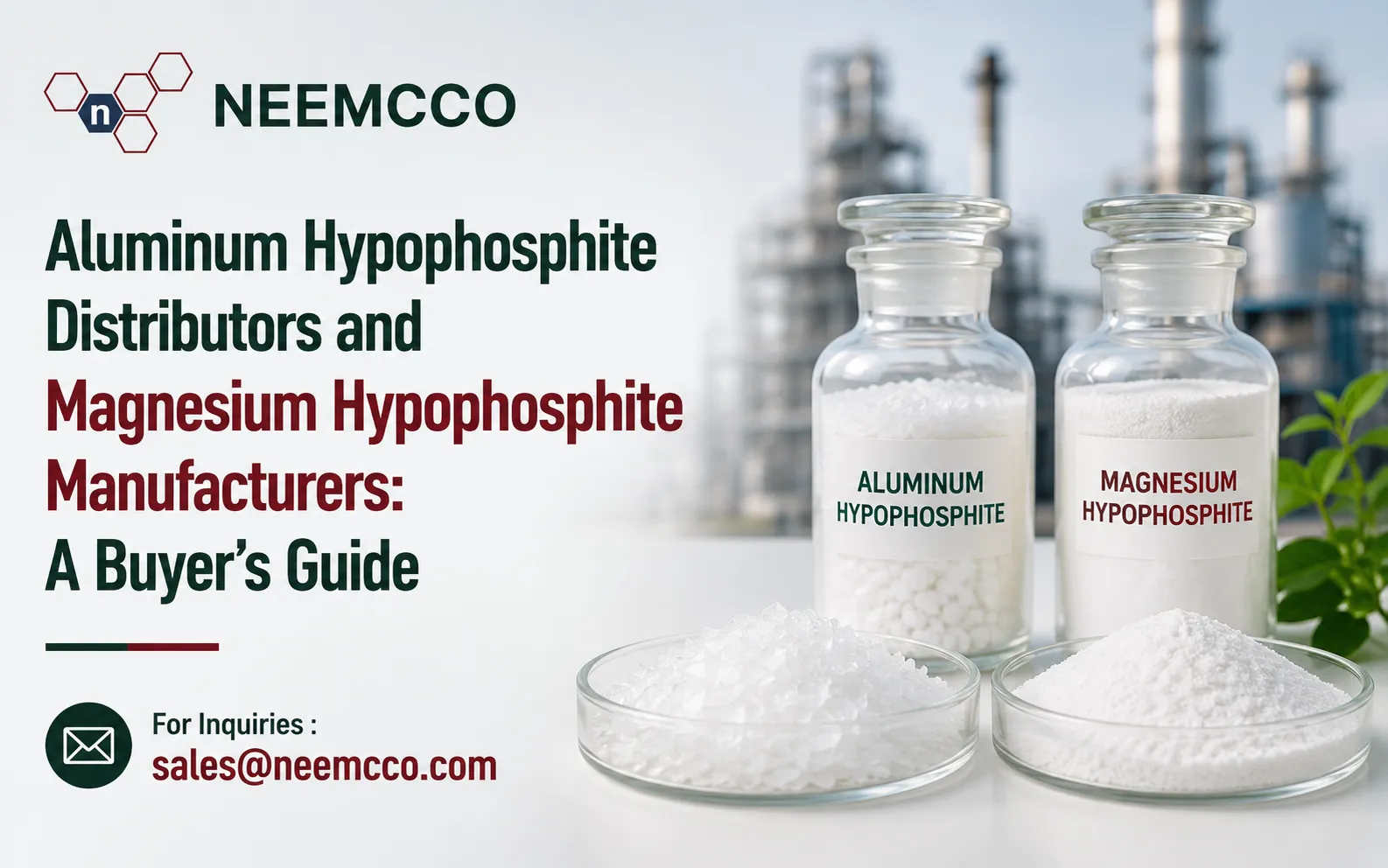
Industrial buyers often work with distributors because distributors can provide local stock, smaller quantities and faster delivery. However, the distributor must have a dependable manufacturing source. This makes it important to evaluate both Aluminum Hypophosphite distributors and Magnesium Hypophosphite manufacturers before beginning regular procurement.
Choosing Aluminum Hypophosphite Distributors
Aluminum Hypophosphite distributors should provide complete technical and commercial information. Aluminum Hypophosphite is mainly used as a non-halogenated flame-retardant additive in plastics and engineering polymers. It is a white powder with low water solubility and good thermal stability.
Ask the distributor for the latest Certificate of Analysis and Safety Data Sheet. The COA should mention assay, phosphorus content, moisture, chloride, pH and other agreed parameters. Particle size information is also useful for plastic compounders because it can influence powder dispersion and final product performance.
The distributor should confirm whether the same grade can be supplied regularly. Changes in particle size, moisture or purity may affect mixing, processing temperature, surface finish and flame-retardant results.
Reliable Aluminum Hypophosphite distributors should provide information about purity, phosphorus content, moisture limits, decomposition temperature and packaging details.
Buyers should also ask about stock availability, minimum order quantity, delivery schedule, country of origin and storage conditions. These details are useful when the chemical is imported or required for continuous production.
Selecting Magnesium Hypophosphite Manufacturers
Magnesium Hypophosphite manufacturers should clearly identify the chemical form being supplied. Magnesium Hypophosphite is often supplied as magnesium hypophosphite hexahydrate. The hydrate form contains water of crystallisation, so the molecular weight and assay basis should be understood before formulation.
The manufacturer should provide information about purity, solubility, heavy metals, iron, sulphate and chloride. These parameters are important in veterinary, nutritional and agricultural applications. Buyers should confirm whether the material is technical grade, resin grade or intended for another use.
Established Magnesium Hypophosphite manufacturers should provide details about solubility, purity, HDPE bag packing and batch-wise COA/SDS support.
Checks Before Bulk Purchase
Request a sample before approving a large order. Test it in the actual formulation and compare the result with the current product. Check packaging strength, labelling, moisture protection and batch traceability.
A good supply partner should answer questions about quality, production capacity, lead time, documents and repeat-order support. Buyers should maintain records of COAs, SDS documents, batch numbers and incoming inspection results.
Reliable procurement depends on consistent material and clear communication. When distributors and manufacturers provide accurate information from the beginning, companies can plan production with greater confidence.
The distributor should also maintain proper storage conditions. The product should be kept in its original sealed packaging unless there is a controlled repacking procedure. Records of incoming inspection, stock movement and batch numbers help the customer maintain traceability.
For long-term supply, buyers should review more than one commercial quotation. Compare documentation, response time, sample quality, delivery reliability and technical assistance. A dependable partner can make routine procurement easier and help the production team respond quickly when requirements change.